

Learn
Star Sapphire: The Complete Guide to Asterism, Color, Origin and Value

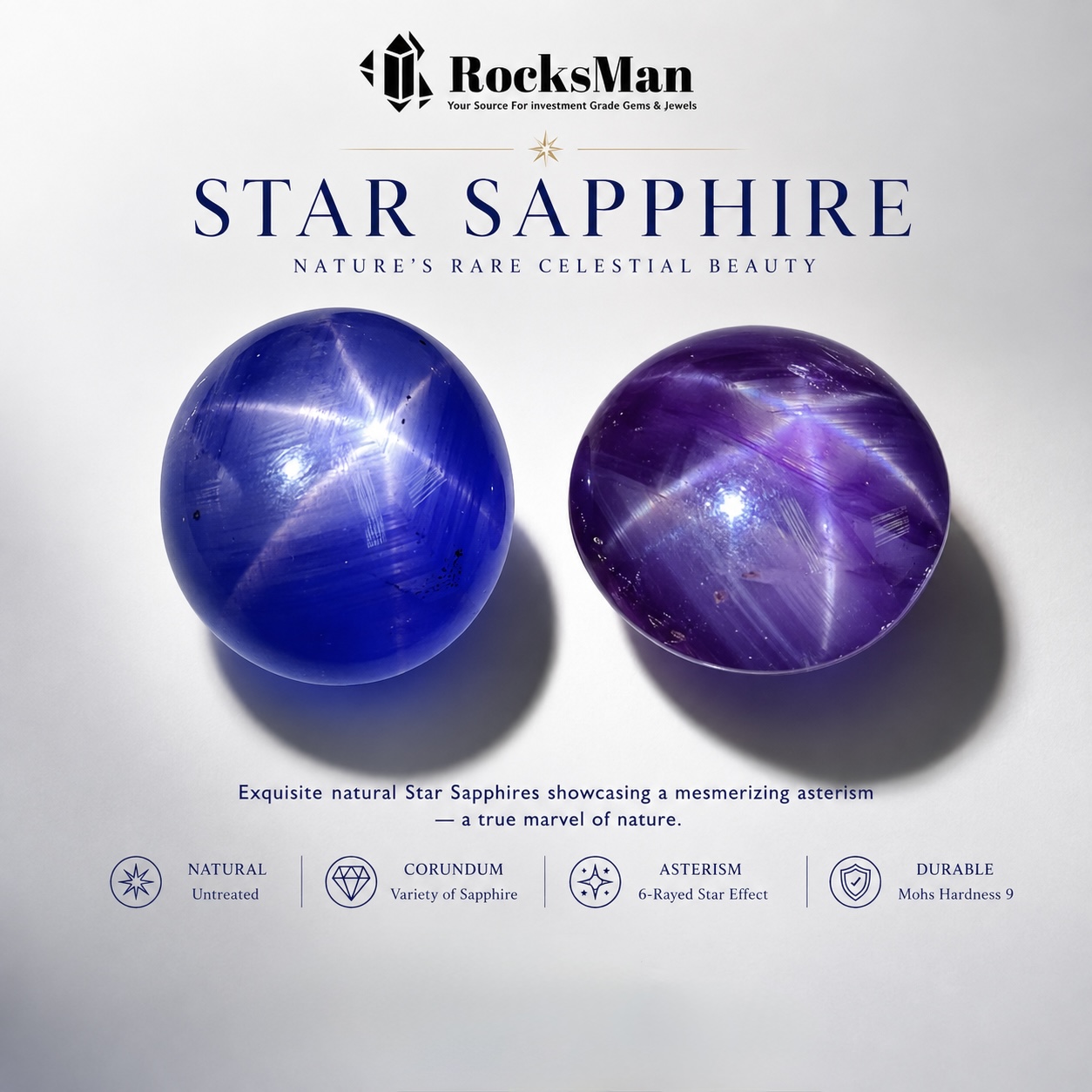
 Some sapphires are admired for their color. Others are remembered because something seems to move across their surface. A fine star sapphire can do exactly that.
Under a single light source, a luminous star appears to float across the smooth dome of the stone. Tilt it slightly, and the star moves with it.
It looks almost magical, but the explanation is entirely natural: microscopic inclusions inside the sapphire interact with light in a very particular way.
That phenomenon is called asterism, and it turns an ordinary-looking cabochon into one of the most fascinating forms of corundum.
What Is a Star Sapphire?
A star sapphire is a sapphire that displays asterism — a star-shaped optical effect visible on the surface of the gemstone.
Sapphire is the non-red variety of the mineral corundum. Star sapphire can occur in several colors, including blue, pink, gray, yellow, purple and black. Red star corundum is classified as star ruby instead.
The star is not painted, engraved or added to the stone. It comes from microscopic inclusions that formed inside the corundum as it grew.
Read GIA’s guide to sapphire quality and star corundum →
How Does the Star Effect Form?
Inside some sapphires are extremely fine needle-like inclusions, commonly associated with rutile. These inclusions can occur in several intersecting orientations.
When light interacts with the oriented inclusions, it is reflected into bright bands. In a typical six-ray star, three sets of intersecting inclusions create six visible rays.
The sapphire must also be oriented and polished correctly. Star sapphires are normally cut as cabochons, with a smooth, rounded dome rather than facets. The curved surface helps concentrate the reflected light into the characteristic star.
The result is one of nature’s most recognizable optical phenomena.
Why Does the Star Move?
This is one of the details that makes a good star sapphire so captivating.
Place the stone under a single light source and slowly rock it. The star appears to glide across the dome rather than remaining fixed in one position.
The movement comes from the relationship between the curved surface, the orientation of the inclusions and the position of the light.
A high-quality star should have smooth, graceful movement rather than a star that looks weak or frozen.
What Makes a Good Star Sapphire?
Simply having a star does not make a sapphire exceptional.
Collectors look at several characteristics at the same time.
Sharpness
The rays should be crisp and clearly defined. A fuzzy or broken star generally has less visual appeal.
Centering
The point where the rays meet should ideally sit near the center of the cabochon’s dome. A centered star gives the gemstone a much stronger sense of balance.
Symmetry
The six rays should ideally be reasonably even in strength and length. Uneven or missing rays can reduce the visual quality of the phenomenon.
Contrast
A bright star needs enough contrast against the body color to be clearly visible. A dark or saturated body color can sometimes make the star stand out dramatically.
Movement
Rock the gemstone under the light. A beautiful star should travel smoothly across the surface.
Body Color and Transparency
The star is only one part of the gemstone. GIA notes that color has a major influence on the value of star corundum, and the finest examples combine a crisp, distinct star with strongly saturated color and enough transparency to give the stone depth.
Too many inclusions can strengthen the star but also make the stone excessively opaque and weaken its color and overall appearance.
See GIA’s star sapphire quality factors →
Six-Ray vs. Twelve-Ray Star Sapphire
Most star sapphires display six rays.
A 12-ray star sapphire is much rarer and can be especially fascinating to collectors.
GIA explains that 12-ray stars can form when two different inclusion systems overlap. One system may be associated with rutile and another with hematite, producing two intersecting star patterns.
The two sets can even produce rays with different colors. This is particularly spectacular in some black star sapphires from Thailand, where golden-yellow and silvery-white rays can overlap to create a 12-rayed star.
Read GIA’s case study of a 12-rayed star sapphire from Thailand →
Black Star Sapphire: The Mysterious Dark Variety
Black star sapphire is one of the most recognizable forms of star corundum.
Interestingly, the stone’s dark appearance does not necessarily mean that the sapphire crystal itself is naturally black.
In some black star sapphires, a high concentration of iron-rich inclusions such as hematite and ilmenite masks the underlying body color. When these inclusions are properly oriented, they can produce a strong golden or silvery star.
Thailand is particularly interesting in this regard. GIA has documented black star sapphire from the Chanthaburi area, including an exceptional 3.6-carat 12-rayed example with one golden set of rays and another silver-white set.
See the documented Thai 12-ray star sapphire at GIA →
Where Do Star Sapphires Come From?
Sri Lanka
Sri Lanka has a long history of producing phenomenal corundum and is an important source of star sapphires. Material from Sri Lanka can occur in blue, gray, pink and other colors, with quality varying considerably from one stone to another.
Thailand
Thailand has a special place in the story of star sapphire, particularly black star sapphire. Eastern Thailand, including the historic Chanthaburi area, has produced material with distinctive asterism and unusual inclusion combinations.
Myanmar
Myanmar is famous for ruby and sapphire, and asteriated corundum has also been found in the region. Fine material is judged by the actual gemstone rather than the origin name alone.
Other Sources
Star sapphire can occur in several other corundum-producing regions, including parts of Africa and Australia. Geographic origin can add interest to an exceptional stone, but origin should be established through appropriate gemological testing when it is important to value.
Are Star Sapphires Rare?
Visible star sapphires are not all equally rare.
A commercial stone with a faint, uneven star is very different from a large sapphire with saturated color, good transparency, a sharp centered star and excellent movement.
The rarity comes from the combination.
Finding a gemstone with the right inclusion pattern is only the beginning. The rough must also produce attractive color, transparency and a well-centered phenomenon after cutting.
Natural Star Sapphire vs. Synthetic Star Sapphire
This distinction is important, especially when buying a valuable stone.
Laboratory-grown corundum can be manufactured with inclusions or structures that create convincing star effects. Some synthetic star sapphires can look impressive even without magnification.
For an important stone, independent laboratory testing can help establish whether the sapphire is natural or laboratory-grown and whether detectable treatments are present.
Is Star Sapphire Treated?
Treatment is an important part of buying sapphire.
Heat treatment is widely used in the sapphire trade, and it can alter color and appearance. Some sapphires are also treated by lattice diffusion, in which chemical elements are introduced during heating to change the color.
GIA notes that treatment can significantly affect sapphire value. For exceptional stones, confirmation from an independent laboratory that there is no evidence of heat can add to rarity and value.
With star sapphire, treatment can also affect the inclusions responsible for the phenomenon, so treatment status should be considered alongside the quality of the star itself.
Read GIA’s guidance on sapphire heat treatment and value →
How Is Star Sapphire Value Determined?
There is no universal price for star sapphire. Value depends on the combination of the stone’s characteristics.
- Star quality: Sharpness, centering, symmetry, contrast and movement.
- Body color: Attractive, saturated color can significantly increase desirability.
- Transparency: Enough transparency to give the stone depth without weakening the star.
- Size: Large stones combining strong color and a fine star can be particularly rare.
- Condition: Fractures and durability concerns can affect value.
- Treatment: Natural, untreated material can be especially desirable when the overall quality is exceptional.
- Origin: A credible origin opinion can add importance to certain collector stones.
- Certification: Independent documentation provides additional confidence for significant purchases.
How to Buy a Natural Star Sapphire
If you are considering a star sapphire, don’t judge it only from a still photograph.
Whenever possible, see the stone under a single light source and move it slowly.
Ask yourself:
- Is the star sharp and clearly defined?
- Is it centered?
- Are the rays reasonably even?
- Does the star move smoothly?
- Does the body color remain attractive around the star?
- Is the stone too opaque?
- Is the stone natural?
- Has treatment been detected?
- Is the stated origin supported by a laboratory report?
For an important gemstone, those questions are far more useful than simply asking how many carats it weighs.
Star Sapphire vs. Faceted Sapphire
A faceted sapphire is designed to return light through its facets and display brilliance.
A star sapphire is designed to reveal something hidden inside the stone.
Its cabochon surface may not sparkle in the same way as a faceted sapphire, but under the right light it reveals a moving star that a faceted stone cannot reproduce.
They are two completely different ways of experiencing sapphire.
Why Star Sapphire Is So Fascinating
Perhaps the most beautiful irony of star sapphire is that the inclusions responsible for the star are the same kind of internal features that might otherwise be discussed when evaluating clarity.
In a phenomenal gemstone, those inclusions become the feature.
The stone is not trying to hide what is inside it.
It is showing it to you.
A fine star sapphire is a small piece of natural optical science — captured, polished and revealed by light.
Frequently Asked Questions About Star Sapphire
What causes the star in a star sapphire?
The star, or asterism, is caused by light interacting with tiny, oriented inclusions inside corundum, commonly needle-like rutile inclusions. The curved cabochon surface allows the reflections to appear as intersecting rays.
How many rays does a star sapphire have?
Six rays are typical. Twelve-ray stars are much rarer.
What is a black star sapphire?
Black star sapphire is a dark-looking form of star corundum. In some material, iron-rich inclusions such as hematite and ilmenite mask the underlying body color and can produce golden or silvery asterism.
Where are star sapphires found?
Important star sapphire has been found in Sri Lanka, Thailand, Myanmar and several other sapphire-producing regions. Thailand is particularly notable for black star sapphire.
Is star sapphire natural?
It can be natural or laboratory-grown. An independent laboratory report is the safest way to establish the identity and natural status of a valuable stone.
Are star sapphires treated?
Some are treated. Heat treatment and other sapphire treatments are encountered in the market, so treatment disclosure is important when buying a significant stone.
Is a 12-ray star sapphire more valuable than a six-ray star?
Not automatically. Twelve-ray stars are rarer, but overall value still depends on color, transparency, star quality, size, treatment, condition and documentation. An exceptional six-ray star can be more desirable than a weak 12-ray star.
Can star sapphire be worn in jewelry?
Yes. Sapphire is corundum and has a Mohs hardness of 9. A well-protected star sapphire can be suitable for jewelry, although cabochons should still be protected from hard impacts and significant fractures should be considered.
Looking for a fine natural star sapphire?
At RocksMan, we source natural, high-quality sapphires from trusted suppliers and gemstone-producing regions.
- Request a custom star sapphire based on your budget, size, color, origin, star quality and treatment preference
- Or explore our available sapphire collection on our website
- Or visit our Sapphire selection on Gem Rock Auctions
Looking for something specific? Tell us the size, body color, origin, star quality and treatment preference you have in mind, and we can help source the right stone.
Further Reading
For additional gemological information, consult independent resources such as the Gemological Institute of America.


