

Learn
Cat’s-Eye Chrysoberyl: The Complete Guide to Chatoyancy, Color, Origin and Value

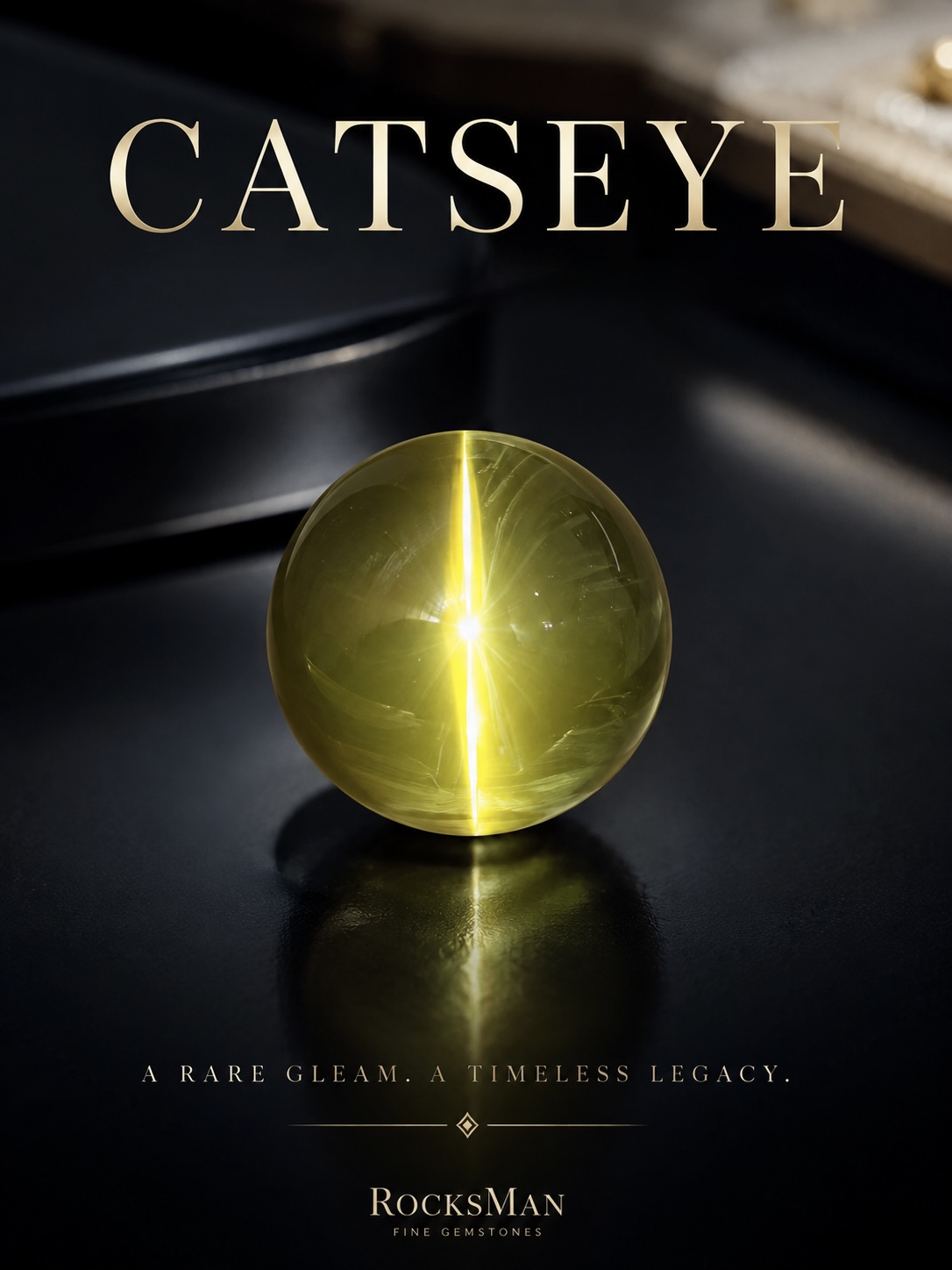
Some gemstones sparkle. Some change color. And then there are gemstones that seem to have a living eye inside them such as Cat’s-Eye Chrysoberyl.
Cat’s-eye chrysoberyl is one of those stones.
Turn a fine cabochon under a single light source and a narrow band of light seems to glide across its surface. Move the stone again, and the eye follows.
It is not a painted line, a reflection added by the cutter, or an optical trick created by a machine.
It is a natural phenomenon called chatoyancy — and in fine chrysoberyl, it can be extraordinarily sharp.
What Is Cat’s-Eye Chrysoberyl?
Chrysoberyl is a gemstone species that is completely different from beryl, despite the similar name. Its cat’s-eye variety is known for a narrow, moving band of light across a polished cabochon.
When gemologists use the term “cat’s-eye” without another gemstone name attached, they are referring to chrysoberyl cat’s-eye. Other gemstones that show the same phenomenon are normally identified by name, such as cat’s-eye tourmaline or cat’s-eye quartz.
GIA describes cat’s-eye as a phenomenal effect in which a bright, narrow band of light appears to glide across a gemstone as it is moved. Cat’s-eye chrysoberyl is considered the most sought-after gemstone showing this phenomenon because of the intensity and quality the best examples can achieve.
Read GIA’s guide to phenomenal gemstones →
What Is Chatoyancy?
The word chatoyancy comes from the French expression for “cat’s eye.” It describes the optical effect that produces the bright band.
In chrysoberyl, tiny oriented inclusions inside the gemstone act like microscopic reflectors. When the stone is cut and oriented correctly, light is reflected from these internal structures into a concentrated line.
The gemstone is normally polished as a cabochon, with a smooth, rounded top. A faceted cut would not display the phenomenon in the same way.
GIA explains that chatoyancy occurs when fibers, needles or other reflective inclusions are aligned in parallel and that the base of the cabochon needs to be oriented correctly to produce an even effect across the dome.
Learn how GIA explains chatoyancy in phenomenal cabochons →
Why Does the Cat’s Eye Move?
This is the part that makes the gemstone so captivating.
Under a point light source, the bright band appears to follow the movement of the stone. As you rotate or rock the cabochon, the eye seems to slide from one side to the other.
A good cat’s-eye should have a sense of movement rather than looking like a fixed white stripe painted across the surface.
The best examples can look almost alive.
What Makes a Fine Cat’s-Eye Chrysoberyl?
Seeing an eye is only the beginning. Collectors pay close attention to the quality of the phenomenon and the gemstone itself.
A Sharp, Narrow Eye
The finest cat’s-eyes have a bright, narrow and well-defined line. A broad or fuzzy band generally has less visual impact.
A Centered Eye
The eye should ideally run cleanly along the center of the cabochon. An off-center eye can make the stone look unbalanced.
Strong Contrast
The bright eye should contrast clearly with the body color. This makes the phenomenon easier to see and gives the gemstone much more presence.
Good Movement
Rock the stone under the light. The eye should appear to glide smoothly across the dome.
Attractive Body Color
The phenomenon is important, but the body color matters too. Chrysoberyl cat’s-eyes are commonly seen in honey, yellow, greenish-yellow and brownish-yellow tones. Attractive color combined with strong chatoyancy can make a major difference to desirability.
Transparency
A fine cat’s-eye needs enough transparency for the stone to retain depth and life. At the same time, the internal inclusions must be sufficiently developed to produce the eye.
The Famous “Milk and Honey” Effect
One of the most desirable visual features in cat’s-eye chrysoberyl is the milk-and-honey effect.
When the stone is illuminated and viewed from the right direction, one side can appear creamy or milky while the other side looks warmer and honey-colored. As the stone moves, the balance between the two areas can shift.
It is one of the reasons fine chrysoberyl cat’s-eyes are so distinctive.
A stone does not need to display a perfect milk-and-honey effect to be valuable, but when strong color, transparency and a sharp eye come together, the result can be spectacular.
Why Inclusions Are Important in Cat’s-Eye
Normally, gemstone buyers are taught to look for fewer inclusions.
Cat’s-eye chrysoberyl is different.
The inclusions are responsible for the phenomenon.
Without the right internal structures, there would be no eye.
The real goal is therefore not simply “fewer inclusions.” It is the right inclusions, in the right orientation and concentration, producing the right optical effect while preserving enough transparency and color to make the gemstone attractive.
Where Does Cat’s-Eye Chrysoberyl Come From?
Sri Lanka
Sri Lanka is one of the world’s most important sources of fine chrysoberyl, including cat’s-eye material. Sri Lankan cat’s-eyes are well known among collectors and can show attractive honey, yellow and greenish body colors.
Brazil
Brazil is another important source of chrysoberyl and has produced fine examples of phenomenal material. Brazilian gemstones can show a range of colors and internal features.
Other Sources
Chrysoberyl also occurs in other gemstone-producing regions, including parts of East Africa and Madagascar. Origin can add interest to a significant stone, but the quality of the individual gemstone remains the starting point for evaluation.
How Rare Is Cat’s-Eye Chrysoberyl?
Good chrysoberyl is not the same thing as fine cat’s-eye chrysoberyl.
The stone must have the right internal structure to produce chatoyancy, and then the rough must be oriented and cut correctly. After cutting, the gemstone still needs attractive color, transparency, a sharp eye and good movement.
That combination is what makes exceptional cat’s-eyes rare.
In other words, the rarity is not simply in finding chrysoberyl. It is in finding chrysoberyl that does all the right things at once.
Cat’s-Eye Chrysoberyl vs. Other Cat’s-Eye Gemstones
Chrysoberyl is not the only gemstone capable of showing chatoyancy.
Cat’s-eye effects can also occur in tourmaline, quartz, sapphire, ruby, spinel, garnet, diopside, apatite and several other gemstones.
But there is an important distinction:
“Cat’s-eye” by itself refers to chrysoberyl.
Other materials should normally be named specifically — for example, cat’s-eye tourmaline or cat’s-eye quartz.
The quality of the phenomenon also varies. GIA notes that cat’s-eye tourmaline, for example, can show a softer and more diffused eye because its tube-like inclusions are larger than those responsible for fine chrysoberyl chatoyancy.
See GIA’s information on cat’s-eye tourmaline →
Cat’s-Eye Tourmaline: A Different Kind of Beauty
Although chrysoberyl is the classic cat’s-eye gemstone, tourmaline can produce fascinating examples too.
GIA has documented a Brazilian Paraíba tourmaline with an unusually sharp cat’s-eye effect caused by a layer of fine parallel growth tubes. The combination of vivid blue color, transparency, Brazilian origin and strong chatoyancy made the stone particularly rare.
This is a good reminder that chatoyancy is not limited to one mineral species — but the name of the gemstone still matters.
Read GIA’s case study of cat’s-eye Paraíba tourmaline →
Is Cat’s-Eye Chrysoberyl Treated?
Chrysoberyl is generally encountered with relatively little treatment compared with many other colored gemstones. However, treatment status should still be established for important stones rather than assumed.
A laboratory report can identify the gemstone and document detectable treatments. For a significant cat’s-eye, independent documentation is especially useful because the value can depend heavily on the quality and rarity of the natural phenomenon.
GIA’s current colored-stone services include cat’s-eye chrysoberyl among the gemstones for which it can issue identification reports describing the gemstone and detectable treatments.
See GIA’s current colored-stone report information →
How Is Cat’s-Eye Chrysoberyl Value Determined?
There is no single price for cat’s-eye chrysoberyl.
Several characteristics work together:
- Sharpness of the eye: A narrow, bright and well-defined eye is highly desirable.
- Centering: A centered eye creates stronger symmetry.
- Movement: A lively eye that glides across the dome is more compelling than a static-looking band.
- Color: Attractive honey, yellow and greenish tones can be especially desirable.
- Transparency: Enough transparency to give the stone depth while retaining the inclusions needed for chatoyancy.
- Size: Large stones combining excellent color and a fine eye can be particularly rare.
- Condition: Fractures and durability issues can reduce desirability.
- Origin: A credible origin opinion can add interest to exceptional collector stones.
- Documentation: An independent laboratory report can provide confidence about identity and treatment.
How to Buy a Natural Cat’s-Eye Chrysoberyl
If you are buying a cat’s-eye, do not judge it from a single still photograph.
The phenomenon is dynamic.
Whenever possible, examine the stone under a single point light and move it slowly.
Ask:
- Is the eye sharp and narrow?
- Is it centered?
- Does it move smoothly?
- Is the contrast strong?
- Is the body color attractive?
- Does the stone retain enough transparency?
- Is the gemstone natural?
- Has any treatment been detected?
- Is there an independent laboratory report?
A short video can actually be more informative than a photograph because it shows the eye moving across the stone.
Why Cat’s-Eye Chrysoberyl Is So Fascinating
There is something unusually personal about a cat’s-eye gemstone.
A faceted stone gives you flashes of light. A star sapphire gives you rays. A cat’s-eye gives you a single moving line.
And that line seems to follow you.
It is a small optical phenomenon created by structures too tiny to see with the naked eye — yet those invisible inclusions are what give the finished gemstone its identity.
Fine cat’s-eye chrysoberyl is not simply a gemstone with an interesting inclusion pattern. It is a gemstone whose hidden structure becomes the feature you notice first.
Frequently Asked Questions About Cat’s-Eye Chrysoberyl
What is cat’s-eye gemstone?
When the term “cat’s-eye” is used without another gemstone name, it refers to chrysoberyl cat’s-eye. The effect is called chatoyancy.
What causes the cat’s-eye effect?
Chatoyancy is produced when light interacts with aligned needle-like, fibrous or tube-like inclusions inside a gemstone. In chrysoberyl, the inclusions are oriented so they reflect light into a narrow band.
Is cat’s-eye chrysoberyl rare?
Fine cat’s-eye chrysoberyl is much rarer than ordinary chrysoberyl because the stone needs the right internal structures, orientation, color, transparency and cut to produce a strong eye.
What is the milk-and-honey effect?
It is a desirable appearance in which one side of a cat’s-eye chrysoberyl appears creamy or milky while the other side appears warmer and honey-colored. The balance can shift as the stone is moved.
Where does cat’s-eye chrysoberyl come from?
Sri Lanka is particularly famous for cat’s-eye chrysoberyl. Brazil, Madagascar and other regions have also produced chrysoberyl.
Can cat’s-eye chrysoberyl be synthetic?
Laboratory-grown chrysoberyl exists, so an important stone should be examined by a qualified gemologist or independent laboratory when natural origin matters.
Can cat’s-eye be found in other gemstones?
Yes. Tourmaline, quartz, sapphire, ruby, spinel, garnet and several other gemstones can show chatoyancy. They should be identified specifically, such as cat’s-eye tourmaline or cat’s-eye quartz.
Is cat’s-eye chrysoberyl good for jewelry?
Yes. Chrysoberyl has good durability and is suitable for jewelry. Because cat’s-eye material is normally cut as a cabochon and can contain significant inclusions, the individual stone should still be checked for fractures and protected from hard impacts.
Looking for a fine natural cat’s-eye chrysoberyl?
At RocksMan, we source natural, high-quality chrysoberyl and phenomenal gemstones from trusted suppliers and gemstone-producing regions.
- Request a custom cat’s-eye chrysoberyl based on your budget, size, color, origin and eye quality
- Or explore our available gemstones on the RocksMan website
- Or visit our Chrysoberyl selection on Gem Rock Auctions
Looking for something specific? Tell us the size, body color, origin, eye quality and budget you have in mind, and we can help source the right stone.
Further Reading
For additional gemological information, consult independent resources such as the Gemological Institute of America and the International Colored Gemstone Association.


