

Learn
Star Ruby: The Complete Guide to Asterism, Color, Origin and Value

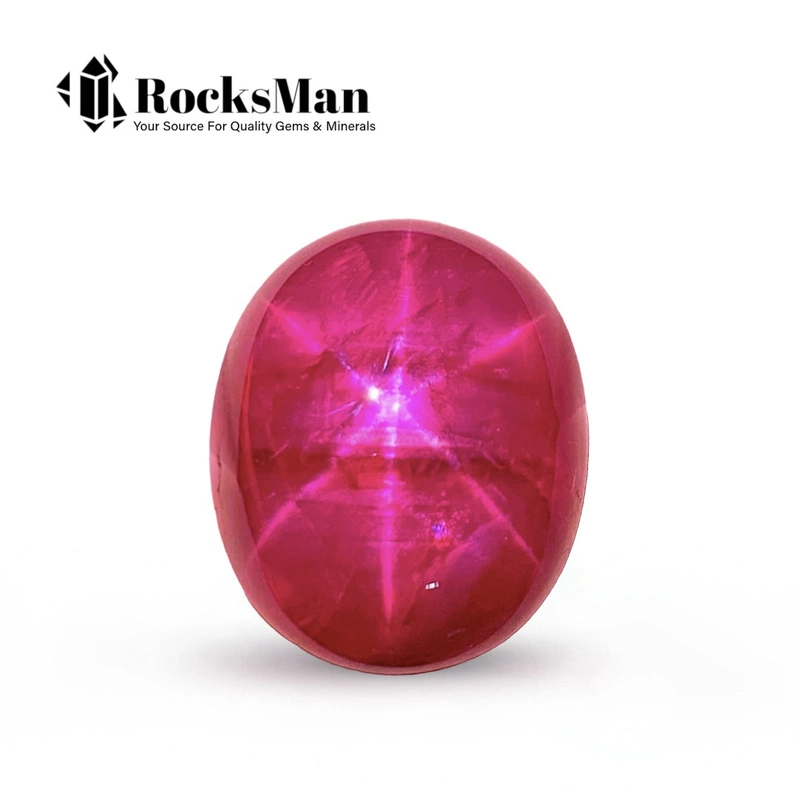
Some gemstones sparkle when they catch the light. A star ruby does something different.
Move it gently, and a luminous star seems to travel across its surface.
That phenomenon is called asterism, and it is one of the most captivating optical effects in the world of colored gemstones. In a fine star ruby, the effect can look almost suspended over the surface of the stone — a sharp, silvery or pale star floating over rich red corundum.
But the star is not painted onto the gemstone, and it is not a trick of the cutter.
It comes from the ruby’s own microscopic internal structure.
What Is a Star Ruby?
A star ruby is a ruby that displays asterism — a star-shaped optical effect visible on the surface of the stone.
Ruby is the red variety of the mineral corundum. When certain needle-like inclusions inside corundum are oriented in particular directions, they can reflect and scatter light into intersecting bands. When the stone is fashioned as a cabochon with the correct orientation, those bands can appear as a star.
Star ruby therefore brings together three things that are fascinating on their own: natural color, microscopic inclusions and the geometry of the crystal.
How Does the Star Effect Form?
Inside some rubies are extremely fine, needle-like inclusions known as silk. When these inclusions occur in several intersecting orientations, light interacts with them to create bright bands. In corundum, three sets can produce the familiar six-ray star. Twelve-ray stars are much rarer.
The curved surface of a cabochon is also essential. It allows the scattered light from the inclusions to be concentrated into the visible rays that appear to float over the dome.
Read more about asterism in corundum at GIA →
Why Does the Star Move?
When you gently rock a star ruby under a light source, the star appears to glide across the dome. This is a result of the relationship between the curved surface of the cabochon, the direction of the inclusions and the incoming light.
A fine star should have elegant movement rather than looking completely static. The best stars appear to move smoothly as the stone is rocked.
What Makes a Good Star Ruby?
Not every ruby that shows a star has a beautiful star. For collectors, the quality of the asterism can be just as important as the body color.
A Sharp, Well-Defined Star
The finest stars are distinct and easy to see. The rays should be straight and clearly separated rather than fuzzy, wavy or broken.
A Centered Star
Ideally, the rays intersect close to the center of the cabochon’s dome. A centered star creates a much stronger visual balance.
Strong Contrast
The star should stand out clearly against the ruby’s body color. A weak, barely visible star generally has less visual impact than a bright star with strong contrast.
Good Movement
A beautiful star should respond to movement. Rocking the gemstone should make the rays travel smoothly across the dome.
Attractive Body Color
The star itself is only part of the story. A spectacular asterism cannot completely compensate for unattractive body color. Fine ruby is prized for strong, attractive red coloration, so the best star rubies combine an appealing body color with a strong phenomenon.
See GIA’s guidance on star quality and corundum →
Why Do Star Rubies Have So Many Inclusions?
In most transparent gemstones, inclusions are discussed as something that can reduce clarity.
Star ruby turns that idea upside down.
The inclusions that create the star are precisely what make the phenomenon possible.
The challenge is finding the right amount and arrangement of inclusions. Too little silk and the star may be weak or absent. Too much can make the stone overly opaque and reduce the quality of its body color.
The finest star corundum generally has enough silk to create a strong star while retaining enough transparency and attractive body color to give the stone life.
Star Ruby vs. Faceted Ruby
A faceted ruby is usually cut to maximize brilliance and the beauty of its color. A star ruby is cut for something different: phenomenal beauty.
The smooth cabochon surface allows the star to appear across the dome. Instead of flashes from individual facets, the viewer sees a moving optical phenomenon.
Neither style is automatically better. They simply highlight different qualities of the same mineral.
Where Do Star Rubies Come From?
Myanmar
Myanmar has a legendary place in the world of ruby, and its historic ruby-producing regions have also yielded star rubies. Exceptional Burmese material is highly regarded when strong red color is combined with a well-defined star and attractive transparency.
Sri Lanka
Sri Lanka is another important source of star corundum and has produced star rubies as well as star sapphires. Sri Lankan material can show a range of body colors and transparency, so the quality of the individual stone remains more important than the country name alone.
Other Sources
Star rubies and other asteriated corundum can occur in several gemstone-producing regions. Geographic origin can be important for exceptional stones, but it should be established through appropriate gemological testing rather than assumed from appearance.
Are Star Rubies Rare?
Star rubies occur more commonly than exceptional star rubies.
A stone that simply shows a visible star is one thing. A large stone with vivid red body color, good transparency, a sharp centered six-ray star, strong contrast and graceful movement is something entirely different.
As with many colored gemstones, rarity increases when several desirable characteristics occur together.
What About 12-Ray Star Rubies?
Most star rubies display six rays. A 12-ray star is much rarer.
Twelve-ray asterism can occur when two different sets of oriented needle-like inclusions overlap. The result can be two six-ray patterns forming a single twelve-ray star. In some corundum, the two sets can even produce stars with different colors.
Because of their rarity, a well-defined 12-ray star can be especially interesting to collectors. However, ray count alone does not determine value. A beautiful six-ray star with exceptional color can be more desirable than a weak 12-ray star.
Explore GIA’s research on unusual star effects in ruby and sapphire →
Natural Star Ruby vs. Synthetic Star Ruby
This distinction is extremely important.
Laboratory-grown star rubies can display convincing asterism. Synthetic asteriated corundum has been produced commercially for decades, and some examples can look remarkably convincing without magnification.
For a valuable stone, a laboratory report can provide useful confirmation of whether the ruby is natural or laboratory-grown and whether treatments have been detected.
Read GIA’s research on natural and synthetic asteriated corundum →
Is Star Ruby Treated?
Treatment is an important consideration when buying any significant ruby, including star ruby.
Heat treatment can alter the appearance of corundum, and treatment history can have a substantial effect on rarity and market value.
The presence of silk can sometimes provide clues about treatment, but it should not be treated as absolute proof that a ruby is unheated. Treatment and the condition of the inclusions need to be assessed with proper gemological methods.
For an important star ruby, independent laboratory testing is the safest approach.
How Is Star Ruby Value Determined?
There is no single price for star ruby. Collectors generally consider several characteristics together:
- Body color: Rich, attractive red is highly desirable.
- Star quality: Sharpness, centering, symmetry, contrast and movement all matter.
- Transparency: Enough transparency to give the stone life without weakening the star.
- Size: Large stones combining strong color and a fine star can be exceptionally rare.
- Condition: Fractures and durability concerns can affect value.
- Treatment: Treatment status can significantly influence rarity and market position.
- Origin: A credible origin opinion can add importance to an exceptional stone.
- Certification: Independent documentation is especially valuable for significant stones.
How to Buy a Natural Star Ruby
If you are looking at a star ruby, don’t immediately ask only how many carats it weighs.
First, look at the star.
Move the stone gently under a single light source. Does the star travel smoothly? Is it centered? Are the rays straight? Does it remain visible from different angles?
Then look at the body color and transparency. Finally, ask about treatment, origin and laboratory documentation.
For a serious purchase, these details can be far more important than a marketing description.
Why Star Ruby Is So Fascinating
There is something almost poetic about star ruby.
The phenomenon isn’t added to the gemstone. It comes from inside it.
The same microscopic inclusions that would normally be discussed under the subject of clarity become the reason the stone is special.
When the ruby is cut correctly and the light hits it at the right angle, those hidden structures reveal themselves as a moving star.
It is a natural optical phenomenon captured inside a gemstone.
Frequently Asked Questions About Star Ruby
What causes the star in a star ruby?
The star, or asterism, is produced by reflections and scattering from tiny needle-like inclusions inside corundum. Their orientation and the curved cabochon surface allow the light to appear as intersecting rays.
How many rays does a star ruby have?
Six rays are typical. Twelve-ray stars are much rarer.
Is a star ruby a real ruby?
Yes, when the material is natural ruby. Star ruby is a phenomenal form of corundum that displays asterism.
Are star rubies more valuable than normal rubies?
Not automatically. Value depends on the quality of the individual stone. An exceptional star ruby can be highly valuable, but a fine faceted ruby may be worth far more than a commercial-quality star ruby.
Where are star rubies found?
Star rubies have been found in several ruby-producing regions, including Myanmar and Sri Lanka. Origin should be verified when it is important to the value of the stone.
Can star ruby be synthetic?
Yes. Laboratory-grown star rubies can display convincing asterism. Independent laboratory testing can distinguish natural from laboratory-grown material.
Is star ruby suitable for jewelry?
Yes. Ruby has a Mohs hardness of 9, making it a durable gemstone. As with any cabochon, the setting should protect the stone from hard knocks and the stone should be checked for significant fractures.
Looking for a fine natural star ruby?
At RocksMan, we source natural, high-quality rubies from trusted suppliers and gemstone-producing regions.
- Request a custom star ruby based on your budget, size, color, origin, and star quality
- Or explore our available ruby collection on our website
- Or visit our Ruby selection on Gem Rock Auctions
Looking for something specific? Tell us the size, body color, star quality, origin and treatment preference you have in mind, and we can help source the right stone.
Further Reading
For additional gemological information, consult independent resources such as the Gemological Institute of America.


