

Learn
Red Spinel: The Complete Guide to Color, Origin, Value and Ruby Comparisons

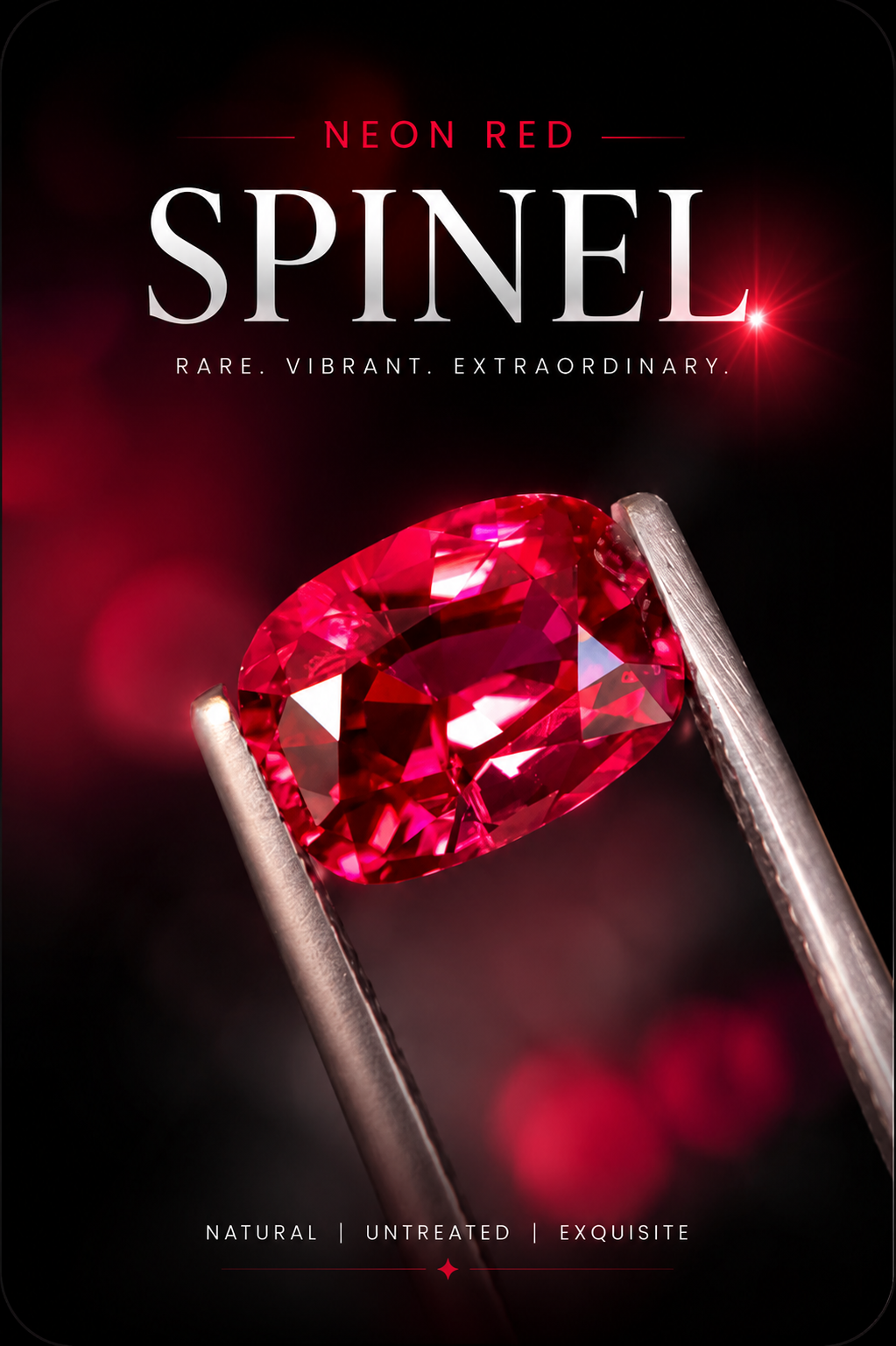
For centuries, some of the most famous “rubies” in royal collections were not rubies at all.
They were red spinels.
The distinction was not properly understood until the development of modern mineralogy and gemology. Today, red spinel has finally begun to receive the recognition it deserves — not as a ruby substitute, but as a beautiful and collectible gemstone in its own right.
And when a red spinel has the right combination of color, transparency and brilliance, it can be extraordinary.
What Is Red Spinel?
Spinel is a separate mineral species from ruby. Its chemical composition is magnesium aluminate, MgAl2O4, and it crystallizes in the cubic system.
Unlike ruby, spinel is singly refractive, meaning it does not show the birefringence found in corundum. It also has a Mohs hardness of about 8, making it durable enough for most jewelry applications.
Red spinel is generally colored by chromium — the same element that plays an important role in the color of ruby.
Why Was Red Spinel Mistaken for Ruby?
The answer is simple: fine red spinel can look remarkably similar to ruby.
Before modern gemological testing, identifying gemstones was far more difficult. Color and appearance were often the main clues available to traders and royalty.
That history produced some extraordinary surprises.
The famous Black Prince’s Ruby in the British Imperial State Crown is actually a large red spinel. The Timur Ruby, another famous historic “ruby,” is also spinel. GIA notes that many celebrated historic rubies were eventually identified as spinel.
What Makes a Red Spinel Valuable?
Not all red spinel is equal. As with ruby and sapphire, the value of a spinel depends on the quality of the individual stone.
Color
Color is usually the most important consideration.
GIA notes that the finest red spinels tend to show pure red to slightly purplish-red hues with medium to medium-dark tone. Vivid, saturated color is especially desirable.
Some exceptional Burmese spinels are famous for their intense, almost glowing red appearance.
Clarity and Transparency
Eye-clean spinel is particularly desirable, but inclusions are not necessarily a bad thing.
Natural spinel can contain fascinating internal features, including inclusions related to its crystal growth. Some can even resemble fingerprints when viewed under magnification.
The important question is whether inclusions interfere with transparency, brilliance or durability.
Cut
A beautiful piece of rough can lose much of its appeal if it is poorly cut.
Spinel is commonly fashioned into cushions and ovals, although many shapes are possible. Because fine spinel rough can be scarce, cutters often make decisions that preserve weight rather than forcing the rough into standard calibrated sizes.
Carat Weight
Large, fine spinels are uncommon. GIA notes that fine-color spinel becomes particularly scarce above five carats, with prices rising sharply as size increases for exceptional red, pink and blue material.
A large red spinel with excellent color and transparency can therefore be a serious collector’s stone.
Where Does Red Spinel Come From?
Myanmar: Mogok and Beyond
Myanmar has produced some of the world’s most celebrated red spinel.
The Mogok region is especially famous among collectors and gemologists. Fine material can show pure red color, strong transparency and, in some cases, striking fluorescence under long-wave ultraviolet light.
GIA research has documented highly fluorescent red spinel from localities including Man Sin in the Mogok Valley and Namya in northern Myanmar.
Tanzania
Tanzania has also become an important source of attractive spinel, including vivid red and hot pink material. The country is particularly associated with the wider modern story of fine spinel becoming more visible to collectors.
Sri Lanka and Other Sources
Sri Lanka and several other regions have produced natural spinel in a broad range of colors. Origin can add interest to an exceptional stone, but the origin should never replace an evaluation of the actual gemstone.
What Is “Jedi Spinel”?
If you have spent time looking at fine spinel, you may have come across the term Jedi spinel.
It is a trade and collector term used for particularly vivid red to reddish-pink spinel associated especially with material from Myanmar. The name became popular because of the intense, almost glowing quality of some stones.
It is important to understand that “Jedi” is not an official laboratory grading category. It is a descriptive market term.
The stone still needs to be judged on its actual color, transparency, cut, size, treatment and documentation.
Is Red Spinel Usually Treated?
One of the reasons collectors find natural spinel attractive is that it is generally encountered with relatively little treatment compared with many other colored gemstones.
GIA describes spinel as rarely treated, although treatment can occur. That makes it particularly important to distinguish between a general market statement and the treatment status of an individual stone.
For a valuable red spinel, an independent laboratory report can provide much greater confidence about whether the stone is natural and whether detectable treatments are present.
Red Spinel vs. Ruby: Which Is Better?
There isn’t a universal answer.
Ruby and red spinel are different gemstones, and both can be spectacular.
Ruby has a hardness of 9, while spinel is about 8 on the Mohs scale. Ruby also has a different optical structure and a much longer-established position at the top of the colored-stone market.
But red spinel has qualities of its own: excellent brilliance, attractive saturated color, a fascinating history and, in fine natural examples, impressive rarity.
The better stone is the one that offers the combination of beauty, rarity, condition, treatment status and documentation that matters to the buyer.
Why Collectors Are Paying Attention to Red Spinel
For a long time, spinel lived in the shadow of ruby.
That is changing.
Collectors have become increasingly interested in gemstones that have a strong geological story, genuine rarity and distinctive beauty. Fine spinel fits that description particularly well.
GIA notes that demand for fine spinel has grown substantially and that, for high-quality material, demand can exceed supply.
There is also something appealing about owning a gemstone whose history includes royal treasures that were once mistaken for something else.
How to Buy a Natural Red Spinel
If you are considering a red spinel, don’t judge it by the word “red” alone.
Look at the stone under different lighting conditions and pay attention to:
- How vivid and saturated is the red?
- Does the stone remain attractive in different lighting?
- Is the tone too dark?
- How transparent is it?
- Are inclusions visible to the naked eye?
- Does the cut produce strong brilliance?
- Is the stone natural?
- Has any treatment been detected?
- Is the stated origin supported by a laboratory report?
Why Laboratory Certification Matters
For an important red spinel, independent laboratory documentation can be extremely useful.
A laboratory can determine whether the material is natural or laboratory-grown and can report detectable treatments. For red spinel, some laboratories can also provide an origin opinion when sufficient evidence is available.
GIA specifically notes that its Colored Stone Identification Report can identify whether spinel is natural or laboratory-grown and document detectable treatments, while red spinel can be submitted for an identification and origin report.
Red Spinel Is More Than a Ruby Alternative
Calling red spinel a “ruby alternative” is understandable, but it doesn’t really tell the whole story.
Spinel has its own mineral identity, its own crystal structure, its own inclusions and its own history.
Its red color can be extraordinary. Its famous historical stones have passed through royal collections. And some of the finest examples from Myanmar and other sources are now highly sought after by collectors who appreciate rarity beyond the usual names.
Perhaps the most interesting thing about red spinel is that it doesn’t need to pretend to be ruby anymore.
It has finally earned the right to be appreciated as spinel.
Frequently Asked Questions About Red Spinel
Is red spinel a ruby?
No. Red spinel and ruby are different mineral species. They can look similar, which is why spinel was historically mistaken for ruby.
Is red spinel rare?
Fine red spinel can be rare, especially when it has vivid color, good transparency, strong brilliance and significant size. Fine material above five carats is particularly uncommon.
Where is the best red spinel from?
Myanmar, particularly the Mogok region and other Burmese localities, is historically important for exceptional red spinel. Other countries, including Tanzania and Sri Lanka, also produce attractive natural spinel.
Is red spinel usually heated?
Spinel is generally rarely treated compared with many other colored gemstones, although treatments can occur. An independent laboratory report is the best way to establish the treatment status of an important stone.
What is Jedi spinel?
“Jedi spinel” is a trade term for exceptionally vivid red to reddish-pink spinel, especially associated with certain Burmese material. It is not an official laboratory grade.
Is spinel durable enough for a ring?
Yes. With a Mohs hardness of about 8 and good durability, spinel is suitable for rings and other jewelry, although normal care is still recommended.
Is red spinel a good alternative to ruby?
It can be an excellent choice for someone who loves vivid red color but wants a different gemstone with its own history and identity. It should be evaluated as spinel rather than simply as a substitute for ruby.
Looking for a fine natural red spinel?
At RocksMan, we source natural, high-quality spinels from trusted suppliers and gemstone-producing regions.
- Request a custom red spinel based on your budget, size, color, and origin
- Or explore our available Red spinel collection on our website
- Or visit our Red Spinel selection on Gem Rock Auctions
Looking for something specific? Contact RocksMan and tell us the color, size, origin, treatment preference and budget you have in mind. We can help source the right stone.
Further Reading
For additional gemological information, see independent resources such as GIA’s Spinel Quality Factors and Spinel Buyer’s Guide.


